Verbete enciclopédico
Noam Chomsky
Nascimento em 1928
Reformulou a investigação da sintaxe por meio de gramáticas gerativas e da pergunta sobre a aquisição da linguagem.
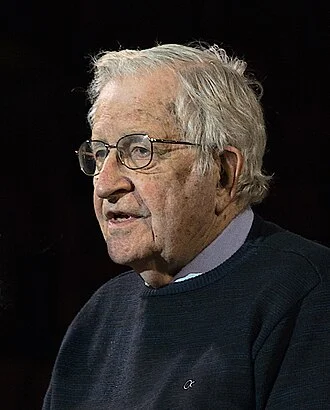

- Áreas
- Ciência política, Linguística
- Períodos
- Século XX, Século XXI
Contexto histórico
Na linguística norte-americana dos anos 1950, a descrição de padrões observáveis convivia com a influência da psicologia behaviorista. Explicar como um falante produz e compreende frases inéditas deslocou a atenção para as capacidades pressupostas pelo uso da língua.
Regiões de atuação histórica · América do Norte
Biografia
Chomsky nasceu na cidade de Filadélfia, no estado da Pensilvânia, nos Estados Unidos, filho de um estudioso do hebraico e professor, William Chomsky. Em 1945, começou a estudar filosofia e linguística na Universidade da Pensilvânia com Zellig Harris, professor com cuja visão política ele se identificou. Antes de receber seu doutoramento em Linguística pela Universidade da Pensilvânia em 1955, Chomsky realizou a maior parte de sua pesquisa nos quatro anos anteriores na Universidade Harvard como pesquisador assistente. Na sua tese de Ph.D., um trabalho de mais de mil páginas, desenvolveu a sua abordagem original às ideias linguísticas, tendo um resumo sido publicado no seu livro de 1957 Syntactic Structures (Estruturas Sintácticas), numa editora neerlandesa, por recomendação de Roman Jakobson. A recensão crítica desta obra por Robert B. Lees teve um papel fundamental na sua divulgação e reconhecimento como trabalho revolucionário.
Trechos de Noam Chomsky, de colaboradores da Wikipédia em português. Seleção sob CC BY-SA 4.0.
- Nascimento
- 1928
- Precisão das datas
- ano
- Última atualização editorial
- 27/11/2026
Genealogia do conhecimento
Antecessores e influências intelectuais
Wilhelm von Humboldt · Chomsky retomou Humboldt ao discutir a capacidade de produzir expressões sempre novas com meios finitos. A referência à criatividade linguística não torna a filosofia humboldtiana idêntica à teoria formal da gramática gerativa.
Contemporâneos e interlocutores
O acervo ainda não documenta vínculos nesta categoria.
Sucessores e desdobramentos intelectuais
O acervo ainda não documenta vínculos nesta categoria.
Genealogia intelectual interativa
Vínculo e documentação
Chomsky retomou Humboldt ao discutir a capacidade de produzir expressões sempre novas com meios finitos. A referência à criatividade linguística não torna a filosofia humboldtiana idêntica à teoria formal da gramática gerativa.
Wilhelm von Humboldt — plato.stanford.edu
Noam Chomsky — MIT Linguistics
Wilhelm von Humboldt — verbete e referências da revisão consultada
Pensamento e principais ideias
Um número aberto de frases
Chomsky perguntou como falantes compreendem sentenças que jamais ouviram. Uma gramática procura descrever o conhecimento que permite construir e reconhecer essas estruturas.
Amplie uma frase encaixando outra oração dentro dela. Observe como regras finitas podem ser reaplicadas para formar expressões mais longas.
A diferença entre um corpus e uma gramática
Uma coleção de enunciados contém apenas frases já produzidas; o falante também julga frases novas. Uma gramática gerativa procura explicitar o conhecimento que torna possível essa produtividade. Permanece em debate quais capacidades são específicas da linguagem e como a experiência participa de sua aquisição.
Bibliografia
Estado do levantamento bibliográfico: parcial.
Catálogo de obras
Ver registros (150)
- The Chomsky–Foucault Debate: On Human Nature
- What Kind of Creatures Are We?
- Logical Structure of Linguistic Theory
- Topics in the Theory of Generative Grammar
- The Sound Pattern of English
- Language and Mind
- The Case Against B.F. Skinner
- Studies on Semantics in Generative Grammar
- The Logical Structure of Linguistic Theory
- Essays on Form and Interpretation
- Morphophonemics of Modern Hebrew
- Language and Learning: The Debate between Jean Piaget and Noam Chomsky
- Rules and Representations
- Lectures on Government and Binding
- Some Concepts and Consequences of the Theory of Government and Binding
- Language and the Study of Mind
- Noam Chomsky on The Generative Enterprise, A discussion with Riny Huybregts and Henk van Riemsdijk
- Modular Approaches to the Study of the Mind
- Knowledge of Language: Its Nature, Origin, and Use
- Barriers. Linguistic Inquiry Monograph Thirteen
- Language in a Psychological Setting
- Language and Problems of Knowledge: The Managua Lectures
- Language and Politics
- Language and Thought
- The Minimalist Program
- On Language
- New Horizons in the Study of Language and Mind
- The Architecture of Language
- On Nature and Language
- The Generative Enterprise Revisited: Discussions with Riny Huybregts, Henk van Riemsdijk, Naoki Fukui, and Mihoko Zushi, with a new foreword by Noam Chomsky
- Of Minds and Language: A Dialogue with Noam Chomsky in the Basque Country
- The Science of Language
- Why only us? Language and Evolution
- Perspectives on Vietnam
- American Power and the New Mandarins
- At War with Asia
- Two Essays on Cambodia
- Chomsky: Selected Readings
- Problems of Knowledge and Freedom: The Russell Lectures
- The Pentagon Papers. Senator Gravel ed. vol. V. Critical Essays
- For Reasons of State
- The Backroom Boys
- Counter-Revolutionary Violence – Bloodbaths in Fact & Propaganda
- Peace in the Middle East? Reflections on Justice and Nationhood
- Intellectuals and the State
- Human Rights and American Foreign Policy
- Language and Responsibility
- The Political Economy of Human Rights, Volume I: The Washington Connection and Third World Fascism
- The Political Economy of Human Rights, Volume II: After the Cataclysm: Postwar Indochina and the Reconstruction of Imperial Ideology
- Superpowers in Collision: The Cold War Now
- Towards a New Cold War: Essays on the Current Crisis and How We Got There
- Turning the Tide: U.S. intervention in Central America and the Struggle for Peace
- Pirates and Emperors: International Terrorism and the Real World
- The Race to Destruction: Its Rational Basis
- The Chomsky Reader
- On Power and Ideology: The Managua Lectures
- Turning the Tide: the U.S. and Latin America
- The Culture of Terrorism
- Necessary Illusions
- Terrorizing the Neighborhood: American Foreign Policy in the Post-Cold War Era
- Deterring Democracy
- What Uncle Sam Really Wants
- Chronicles of Dissent: Interviews with David Barsamian
- Letters from Lexington: Reflections on Propaganda
- Rethinking Camelot: JFK, the Vietnam War, and U.S. Political Culture
- World Order and Its Rules: Variations on Some Themes
- Year 501: The Conquest Continues
- Keeping the Rabble in Line: Interviews with David Barsamian
- Secrets, Lies, and Democracy
- World Orders, Old and New
- Class Warfare: Interviews with David Barsamian
- Class Warfare: Interviewed by David Barsamian
- Objectivity and Liberal Scholarship
- The Cold War and the University
- Democracy in a Neoliberal Order: Doctrines and Reality
- The Common Good
- Latin America: From Colonization to Globalization
- Acts of Aggression: Policing "Rogue" States
- The New Military Humanism: Lessons from Kosovo
- Profit over People: Neoliberalism and Global Order
- A New Generation Draws the Line: Kosovo, East Timor and the Standards of the West
- Rogue States: The Rule of Force in World Affairs
- Propaganda and the Public Mind
- 9-11
- The Umbrella of US Power: The Universal Declaration of Human Rights and the Contradictions of US Policy
- Chomsky on Democracy and Education
- Pirates and Emperors, Old and New: International Terrorism and the Real World
- Peering into the Abyss of the Future
- Understanding Power: The Indispensable Chomsky
- Power and Terror: Post-9/11 Talks and Interviews
- Middle East Illusions: Including Peace in the Middle East? Reflections on Justice and Nationhood
- Hegemony or Survival: America's Quest for Global Dominance
- Deep Concerns
- Chomsky on Miseducation
- Getting Haiti Right This Time: The U.S. and the Coup
- Chomsky on Anarchism
- Government in the Future
- Imperial Ambitions: Conversations on the Post-9/11 World
- A Hated Political Enemy: Allen Bell interviews Noam Chomsky
- Failed States: The Abuse of Power and the Assault on Democracy
- Perilous Power. The Middle East and US Foreign Policy. Dialogues on Terror, Democracy, War, and Justice
- Interventions
- What We Say Goes: Conversations on US Power in a Changing World
- Inside Lebanon: Journey to A Shattered Land with Noam and Carol Chomsky
- The Essential Chomsky
- Hopes and Prospects
- New World of Indigenous Resistance
- Making the Future: The Unipolar Imperial Moment
- Gaza in Crisis: Reflections on Israel's War Against the Palestinians
- The Global Industrial Complex: Systems of Domination
- Scorched Earth: Legacies of Chemical Warfare in Vietnam
- Power and Terror: Conflict, Hegemony, and the Rule of Force
- How the World Works
- 9-11: Was There An Alternative?
- A New Generation Draws the Line: Humanitarian Intervention and the "Responsibility to Protect" Today
- Making the Future: Occupations, Interventions, Empire and Resistance
- Occupy
- Ilusionistas
- Power Systems: Conversations on Global Democratic Uprisings and the New Challenges to U.S. Empire
- Occupy: Reflections on Class War, Rebellion and Solidarity
- Nuclear War and Environmental Catastrophe
- On Anarchism
- On Western Terrorism: From Hiroshima to Drone Warfare
- Masters of Mankind: Essays and Lectures, 1969-2013
- Democracy and Power: the Delhi Lectures
- Because We Say So
- On Palestine
- Who Rules the World?
- Requiem for the American Dream: The 10 Principles of Concentration of Wealth & Power
- Optimism over Despair: On Capitalism, Empire, and Social Change
- Global Discontents: Conversations on the Rising Threats to Democracy (American Empire Project)
- Yugoslavia: Peace, War, and Dissolution
- Internationalism or Extinction
- Climate Crisis and the Global Green New Deal: The Political Economy of Saving the Planet
- Chomsky for Activists
- Consequences of Capitalism: Manufacturing Discontent and Resistance
- The Precipice: Neoliberalism, the Pandemic and Urgent Need for Radical Change
- The Withdrawal: Iraq, Libya, Afghanistan, and the Fragility of U.S. Power
- Notes on Resistance
- Illegitimate Authority, Facing the Challenges of Our Time
- On Cuba: Reflections on 70 Years of Revolution and Struggle
- A Livable Future is Possible: Confronting the Threats to Our Survival
- The Myth of American Idealism: How U.S. Foreign Policy Endangers the World
- Keeping the Rabble in Line
- Class Warfare
- Imperial Ambitions: Conversations With Noam Chomsky On The Post-9/11 World
- What We Say Goes: Conversations on U.S. Power in a Changing World
- On Globalization, Iraq and Middle East Studies
- On the NATO Bombing of Yugoslavia
- Activism, Anarchism, and Power
Produções listadas na Wikipédia
Ver registros (32)
- Syntactic Structures
- Aspects of the Theory of Syntax
- Cartesian Linguistics
- Sound Pattern of English
- Current Issues in Linguistic Theory
- Reflections on Language
- Lectures on Government and Binding: The Pisa Lectures
- Noam Chomsky on The Generative Enterprise, A discussion with Riny Hyybregts and Henk van Riemsdijk
- Barriers
- Language and Problems of Knowledge
- Generative Grammar: Its Basis, Development and Prospects
- O poder americano e os novos mandarins
- Problemas do conhecimento e da liberdade
- Razões de Estado
- Rumo a uma nova Guerra Fria
- Contendo a democracia
- O lucro ou as pessoas?
- Uma nova geração define o limite
- 11 de setembro
- Para Entender o Poder — O Melhor de Noam Chomsky
- Piratas e imperadores: antigos e modernos
- O Império Americano — Hegemonia ou Sobrevivência
- Poder e terrorismo
- O governo no futuro
- Notas Sobre o Anarquismo
- Estados fracassados
- Novos horizontes no estudo da linguagem e da mente
- Sobre natureza e linguagem
- Linguagem e mente
- O Controle da Mídia
- Quem Governa o Mundo?
- The Prosperous Few and the Restless Many
Publicações e escritos
Ver registros (25)
- Deux heures de lucidité : entretien avec Noam Chomsky
- A Responsabilidade de Intelectuais
- Manufacturing Consent
- Failed States
- Hegemony or Survival
- The Secrets of Words
- Midnight on the Mavi Marmara
- The Fateful Triangle
- Pirates and Emperors, Old and New
- Middle East Illusions
- Year 501
- Media Control: The Spectacular Achievements of Propaganda · Media Control
- Remarks on Nominalization
- Power Systems · Power Systems: Conversations on global democratic uprisings and the new challenges to US empire
- Requiem for the American Dream
- Powers and Prospects · Powers and prospects
- The Political Economy of Human Rights
- Profit over People
- The Withdrawal
- Making the Future
- Getting Haiti Right This Time
- Gaza in Crisis
- Knowledge of Language
- Imperial Ambitions
- The Myth of American Idealism
Catálogos consultados na Wikipédia
Pesquisas acadêmicas
Estudos clássicos e fundamentais
Ainda sem registros catalogados.
Pesquisas acadêmicas contemporâneas
- Noam Chomsky: um autor, duas imagens?
Roberto Leiser Baronas, Júlio Ântonio Bonatti Santos · 2018 · Revista da Anpoll · Artigo · Acesso não identificado
DOI 10.18309/anp.v1i45.1177
Pesquisas interdisciplinares
Ainda sem registros catalogados.
Teses e dissertações
Ainda sem registros catalogados.
Revistas, instituições e grupos de pesquisa
Ainda sem registros catalogados.
Referências
Pesquisas acadêmicas contemporâneas
- Roberto Leiser Baronas, Júlio Ântonio Bonatti Santos (2018). Noam Chomsky: um autor, duas imagens?. Revista da Anpoll. Ficha da pesquisa